Featured resources
From "Down To Write You This Poem Sat" at the Oakville Gallery
- Charles Bernstein, "Phone Poem" (2011) (1:30): MP3
- Caroline Bergvall, "Love song: 'The Not Tale (funeral)' from Shorter Caucer Tales (2006): MP3
- Christian Bôk, excerpt from Eunoia, from Chapter "I" for Dick Higgins (2009) (1:38): MP3
- Tonya Foster, Nocturne II (0:40) (2010) MP3
- Ted Greenwald, "The Pears are the Pears" (2005) (0:29): MP3
- Susan Howe, Thorow, III (3:13) (1998): MP3
- Tan Lin, "¼ : 1 foot" (2005) (1:16): MP3
- Steve McCaffery, "Cappuccino" (1995) (2:35): MP3
- Tracie Morris, From "Slave Sho to Video aka Black but Beautiful" (2002) (3:40): MP3
- Julie Patton, "Scribbling thru the Times" (2016) (5:12): MP3
- Tom Raworth, "Errory" (c. 1975) (2:08): MP3
- Jerome Rothenberg, from "The First Horse Song of Frank Mitchell: 4-Voice Version" (c. 1975) (3:30): MP3
- Cecilia Vicuna, "When This Language Disappeared" (2009) (1:30): MP3
- Guillaume Apollinaire, "Le Pont Mirabeau" (1913) (1:14):
MP3
- Amiri Baraka, "Black Dada Nihilismus" (1964) (4:02): MP3
- Louise Bennett, "Colonization in Reverse" (1983) (1:09): MP3
- Sterling Brown, "Old Lem " (c. 1950s) (2:06): MP3
- John Clare, "Vowelless Letter" (1849) performed by Charles Bernstein (2:54): MP3
- Velimir Khlebnikov, "Incantation by Laughter" (1910), tr. and performed by Bernstein (:28) MP3
- Harry Partch, from Barstow (part 1), performed by Bernstein (1968) (1:11): MP3
- Leslie Scalapino, "Can’t’ is ‘Night’" (2007) (3:19): MP3
- Kurt Schwitters, "Ur Sonata: Largo" performed by Ernst Scwhitter (1922-1932) ( (3:12): MP3
- Gertrude Stein, If I Told Him: A Completed Portrait of Picasso (1934-35) (3:42): MP3
- William Carlos Willliams, "The Defective Record" (1942) (0:28): MP3
- Hannah Weiner, from Clairvoyant Journal, performed by Weiner, Sharon Mattlin & Rochelle Kraut (2001) (6:12): MP3
Selected by Charles Bernstein (read more about his choices here)
|
Posted 4/26/2024
I'll admit I chuckled a little when I read about the decision to join us in our new publishing endeavor: I told him at the time that I thought the whole blog thing was dying, that we had all slowed down on Blogger, and that with the Buffalo List seemingly on fumes at that point, Ron Silliman having slowed as well, and social media booming, the age of the poetry blog was winding down. Did we want to move to Jacket2's new thing just to watch it all end? "Of course!" Jerry shouted into the phone. There was a crackling sound as the receiver hit its max volume and the audio broke slightly. I didn't argue — just agreed. Whatever Jerry was up to, I wanted in. And needless to say, we are grateful for Jerry's enthusiasm and everything that's followed! Later, after lamenting their distant friendship, Trivedi shares a luminous memory of seeing Rothenberg read in person: We had been lucky to run into each other a few times in person over the years, despite entire books of the Americas of our own in the middle. I was doing an MFA and a PhD and adjuncting and broke but there was always an invite on every call to visit Encinitas. Thankfully, the last year I was in person doing my PhD, we managed to get Jerry out for a couple of nights to do a reading and interview to Normal, Illinois. Watching him read to a packed room after a few glasses of wine, all of us sweaty and tired on an April night, is going to be a happy memory a lot of us get to carry forward. As I say, anyone mourning the loss of Jerry Rothenberg will take solace from Trivedi's remembrance. Click here to read it in its entirety.
Posted 4/23/2024
How do you begin to describe the many lives of Jerry Rothenberg, who passed away on Sunday at the age of ninety-two? His output as poet alone, or translator, or editor, or anthologist would be enough to secure his reputation for the ages, and yet he excelled in all those areas and more with equal brilliance, fervor, and prescience.
The poetry world we inhabit has been shaped over and over again by Rothenberg's vision, which comprehensively traces an evolution in Western poetics from Romanticism through Modernism to the present, while also inviting a diverse array of marginalized voices to take an equal place at the table. Who else could find profound commonalities that transcended time and space, or trace mercurial ideas into the most obscure corners of expression? Who else could subvert the anthology's colonial trappings, creating cherished collections — Technicians of the Sacred: A Range of Poetries from Africa, America, Asia, [Europe], & Oceania; Shaking the Pumpkin: Traditional Poetry of the Indian North Americas; and A Big Jewish Book: Poems & Other Visions of the Jews from Tribal Times to the Present; among others — that envision a pluralistic and egalitarian, almost utopian, worldview entire generations before the literary mainstream caught up with him? 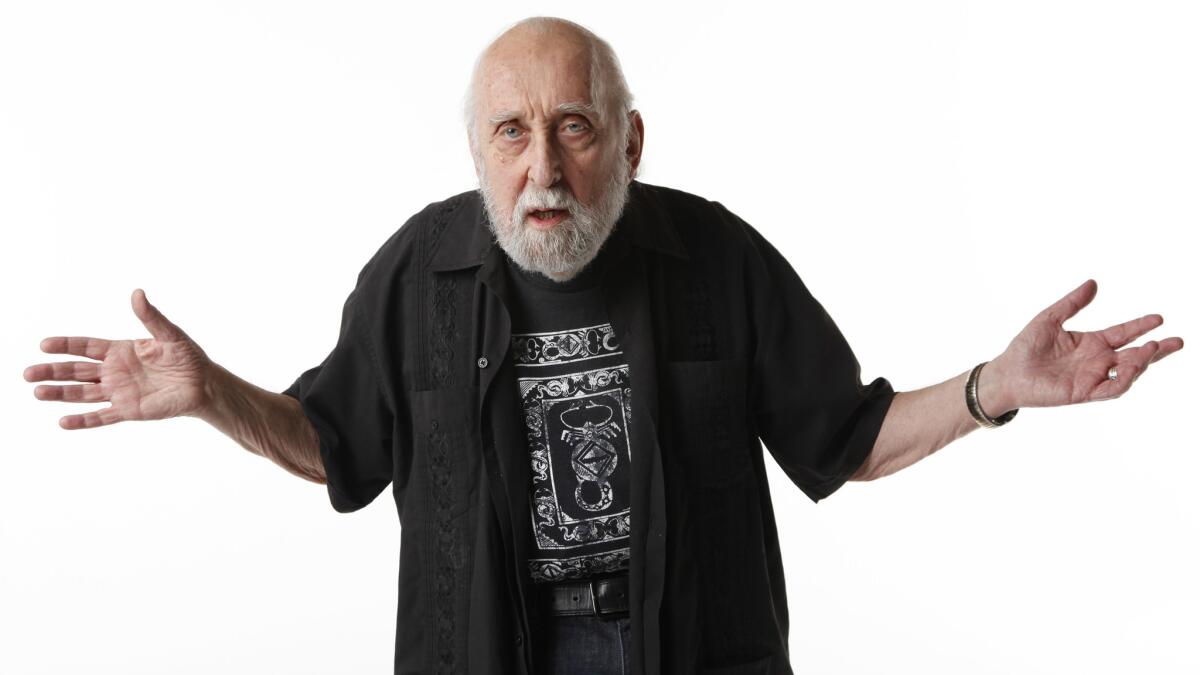 The Rothenberg family broke the news on Sunday night with the following note: After a lifetime spent passionately discovering new poetic possibilities, Jerry passed away on April 21, 2024, at the home he shared with Diane Rothenberg, his wife and collaborator of 71 years. Until the end of his life, he remained actively engaged as a poet, anthologist and performer — and as a devoted friend to his global community. His final projects will come out in 2024, including a massive "omnipoetics" anthology of the Americas co-authored with Javier Taboada; a new studio project with bassist Mark Dresser; and the first performance of "Abraham Abulafia visits the Pope: A fragment of a Steinian opera," conceived and planned with composer Charlie Morrow.
Our own Al Filreis offered this remembrance on behalf of the UPenn community: "Here at the Writers House our hearts go out to Diane and Matthew and all of Jerry's many, many friends. Jerry and Diane visited KWH a number of times over the years. We were blessed by his poetry and his overall poeticness." He concluded, "[Rothenberg] always felt — and said — the poetry should be learned 'where poetry actually happens.' And he of course made it happen in whatever space he joined." Charles Bernstein offered a more succinct tribute: "Infinite sadness to get this news, infinite happiness for Jerry’s life, work, lifelong friendship."  I was lucky to meet Jerry during his time as a KWH Fellow in 2008 and to see him again here in Cincinnati in 2011 and Ann Arbor in 2013, and I would be hard pressed to think of a poet with a more magnetic presence in a live setting. He'd have you doubled over with laughter one minute, wiping tears from your eyes the next, and enraptured throughout — indeed, I never saw him read without entering into an almost transcendent state, suffused with a sense of peace and wellbeing. I had always hoped to see him read again, to get back to that place of preternatural poetic calm, but sadly it appears that I'll no longer have the chance. 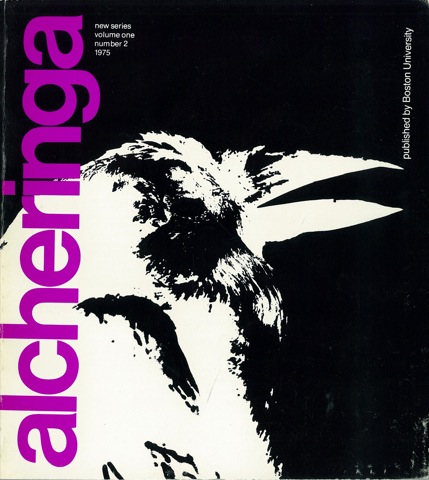 As always, in times of profound loss, it's natural to turn back to the work itself, where a beloved author lives eternally. PennSound's Jerry Rothenberg author page is an excellent place to do exactly that, with well over 350 individual tracks taken from dozens of events spanning more than half a century. These include readings, interviews, panel discussions and talks, albums, performances, podcasts, films, and more. We also direct our listeners to Jacket2, where we were honored to host Jerry's commentary series, "Poems and Poetics," since our launch, and don't forget about our Reissues section, where you browse the complete runs of the groundbreaking journals Alcheringa (1970–1980, co-edited with Dennis Tedlock) and New Wilderness Letter (1977–1984). In a year full of unfathomable losses, Jerry Rothenberg's departure overshadows all others. It truly feels like the end of an era. We join with his family, friends, and fans worldwide in celebrating the life and work of this singular talent.
Posted 4/18/2024
April 18th is the birthday of Bob Kaufman, a quintessential San Francisco poet of the post-war period, who served as a vital bridge between jazz poetry's development during the Harlem Renaissance and its ongoing evolution during the Beat era on both coasts. Kaufman was an innovator in the surrealist tradition, as well as co-founder of the germinal journal Beatitude, and a vital voice that continues to inspire generations of writers. Born in 1925, Kaufman — who died in 1986 — would have turned 98 today.
PennSound's Bob Kaufman author page, c urated by Raymond Foye — who co-edited 2019's Collected Poems of Bob Kaufman from City Lights with Neeli Cherkovski and Tate Swindell — is anchored by Bob Kaufman, poet: the life and times of an African-American man, a stunning 1992 audio documentary written and produced by David Henderson, which comes to us courtesy of Naropa University Audio Archive, Henderson, and Cherkovski. Extensive timetables have also been generated for both one-hour installments, providing details on the various speakers, topics discussed, etc. Individual poems read by Kaufman have also been broken out into their own MP3 files. Additionally, we're proud to be able to share a twenty-one minute recording made by A. L. Nielsen, for which we have no details regarding date or location, and a brief recording of Kaufman reading the poem "Suicide," which comes to us courtesy of Will Combs. Combs' recording forms the basis for PoemTalk #158, in which Christopher Stackhouse, Maria Damon, and Devorah Major join host Al Filreis for a discussion of the poem. Click here to start browsing.
Want to read more? Visit the PennSound Daily archive.
|
New at PennSound
- Spring 2024 Boise State Reading Series: Christina Piña, CAConrad, Jennifer Moxley, Endi Bogue Hardigan, Rob Schlegel, and Ian Dreiblatt
- Belladonna* GIST #2 featuring Kaleem Hawa and Rachelle Rahmé, Center for Brooklyn History, March 23, 2024
- George Quasha reading strange beauty by stranger attraction, Barrytown, NY, March 18, 2024
- Richard Foreman at Segue / Artist Space, New York City, March 16, 2024
- Belladonna* GIST #1 featuring Peter Myers and Jameson Fitzpatrick, Brooklyn Central Library, February 24, 2024
- Six Poems by Giovanni Fontana
- Barbara Henning reading with Jaime Manrique, St. Mark's Poetry Project, January 27, 1993
- George Quasha reading crossroads angelics, Barrytown, NY, December 30, 2023
- Charles North reading for the William Corbett Poetry Series, MIT Virtual Event, April 21, 2022
- VOX Audio Collection, 2005–2011
- Fall 2023 readings at Boise State University's Hemingway Center: Peter Gizzi,
Dan Beachy-Quick, Srikanth Reddy, and Alice Notley
- New author page: Davide Balula
- Hugh Seidman: New Author Page
- Paul Dutton's Oralizations, actuellecd, 2005
- Richard Foreman's production of John Zorn's Astronome,
2010, film by Henry Hills
- Jena Osman and Adam Pendleton reading for the launch of A Very Large Array, Artbook @ MoMA PS1 Bookstore, October 21, 2023
- The Swan 20: Dorota Czerner, September 2, 2023
- Tracie Morris and Tongo Eisen-Martin performing for the Flow Chart Foundation, Hudson, NY, September 22, 2023
- Harryette Mullen on Morton Marcus's "The Poetry Show," KUSP, March 18, 1987
- Ann Lauterbach reading at 'T' Space, Rhinebeck, NY, July 8, 2017 and July 16, 2023
- Ron Padgett reading for the Yale Literary Magazine, November 1, 2022
- A reading with Chris Martin and Adam Wolfond, February 15, 2023
- Julia Bloch reading Valley Oak for PoemADay, August 12, 2023
- Clark Coolidge, The Painter's Poet: a talk on Philip Guston, Poets House, April 4, 2013
- Philip Whalen reading at National Poetry Festival, Allendale, MI, July, 1971
- Lew Welch reading The Song Mt. Tamalpais Sings, Planning and Conservation League, date unknown
- Philip Whalen reading at the Unicorn Bookshop, Santa Barbara, February 6, 1967
- Performance of Louis Zukofsky's "A"-24 Act I at UCSD New Writing Series, April 11, 1986.
- Leslie Scalapino reading in the USCD New Poetry Series, May 9, 1979
- Jerome Rothenberg and Bertram Turetzky Performing For Poet's Voice and Contrabass, 1984
- Hoa Nguyen reading at Kelly Writers House, February 28, 2023
- Joan Retallack reading and conversation for Kelly Writers House Fellows Program, February 20–21, 2023
-
- Barbara Henning and Maureen Owen reading from Poets on the Road, May 27, 2023
- Ron Silliman and Lyn Hejinian reading, November 6, 1995
- Robert Creeley reading for Lannan Foundation, Los Angeles, April 16, 1990
- Thin Air Lectures with Ron Silliman, Alice Notley, Bernadette Mayer, and Ron Padgett, St. Marks Church, May 1988
- Kass Fleisher interview on The Bear River and the Making of History, Access Utah, Utah Public Radio, June 25, 2004
- Cliff Fyman reading, San Francisco, CA, June 11, 2023
- Charles Olson reads from Maximus Poems IV, V, VI, c. 1969
- The Marginalization of Poetry, Segue Series at Double Happiness, NYC, March 22, 1997
- Adam Fieled reading from Equations: The Thesis Episodes, Carriage Hill, Plymouth Township, 2023
- New videos for Aaron Kramer
- Thomas Devaney reading at Wexler Studio, Kelly Writers House, University of Pennsylvania, May 30, 2023
- New video of Joan Retallack for Alternative Poetries and Alternative Pedagogies Reading and Discussion at the Kelly Writers House, February 28, 2001
- Clark Coolidge reading from A Book
Beginning What and Ending Away for 80 Langton Street Writers In Residence Readings,
October 15–21, 1979
- Vincent Katz reading at Green Arcade, SF, November 18, 2022
- George Quasha reading flayed flaws & other finagled opacities, Barrytown, NY, May 5, 2023
- Joel Newberger's The Swan reading series, nos. 2 & 25
- William Fuller Wexler Studio Recording Session, March 16, 2023
|

 PennSound on Facebook
 PennSound on Twitter
 PennSound on YouTube