English 62 / Comparative Literature 62
Twentieth Century Poetry (but not from the U.S.)
Charles Bernstein <charles.bernstein ***@ *** english.upenn.edu>
Spring 2017
Mondays at 6pm
Introduction
Requirements
Discussion list (please subsribe): Re-Wreading
Please email me immediately if you find a bad link.
Note: English 269 and English 288 –– 20th Century American Poetry — and English 262 (post-1975) are the companion courses to English 62.
This syllabus is a work in progress and subject to change.

Required Books (at Penn Book Center)
Jerome Rothenberg and Pierre Joris, eds., Poems for the
Millennium Vols 1 and 2
Dialogues with Marcel Duchamp by Pierre Cabanne, tr. Ron
Padgett
Ko Ko Thet, The Burden of Being Burmese
Recommended (some copies at Penn Book Center)
Modernisms: A Literary Guideby Peter Nicholls
The Futurist Moment: Avant-Garde, Avant Guerre, and the Language of Rupture by Marjorie Perloff
•
class lecture in first sessions: modernist
time line
a related general introduction to the radical moment of 1913 in a one-hour radio program (from Dec. 2012) by Sara Fishko: hereexcerpt just on poetry here and .
INTRO (Jan. 11) Introduction
Before this first class. try a Poem Profiler self-test: fill out the profiler in the abstract, to reflect your own preferences (see "course requirements"), and post to the list.
Tues., Jan. 17 at 6, KHW, Alan Bernheimer reading his translation of French Surralist Phillip Soupault (see 7A below!)
 reading highlight
1. (Jan. 23) Ko Ko Thett visit: Burmese poetry.
We will meet at 6pm at the Kelly Writers House.
Ko Ko Thet, The Burden of Being Burmese
(Penn Book Center)
On Ko Ko Thett
Zeyar Lynn, Language-Oriented Poetry in Burma ; his poems, "Slide Show"
Bones Will Crow (listen to the radio programs); intro and Zeyar Lynn poem
Jet Ni [Ko Ko Thett], New Year's Round Robin and 2016 version, 2012
Ko Ko Thett, Funeral of Rugged Gold
Pandora, more Pandora
Review of The Burden of Being Burmese; review of Bones Will Crow
At KHW, Ko Ko Thett will read and I will interview him for a Close Listening radio show. We will then take a break and you will have a chance to ask questions. Please prepare two or three questions for him.
Journal: write responses to specific poems and post to the list.
2. (Jan. 30) Yeats and British poetry
2A. Yeats

W. B. Yeats & Gale (1865-1939): "A Vision" (only in print anthology!) and "The Second Coming" (1919)
in PM1 (the assigned anthology!);
___ "Lake
Isle of Innisfree" (1893) and "Sailing to Byzantium" (1927) (via class
e-library: password required); or on e-mule: "Innisfree," "Sailing,"
"Second " ;
plus "The
Song of Wandering Aengus " (published 1899) (Donovan song version)
Audio: (1)Yeats
reading "Lake Isle of Innisfree": PennSound 3 versions; (2)
his comments on this poem, and (3) his 1936 comments "On
Modern Poetry"
Extenstion (optional):
Hamilton
Camp's 1964 folk setting of "Innisfree"
Xu Bing's calligraphic "Song of Wandering Aengus"
Further information on Yeats, including biography and complete
poems, is available from LION via library e-recources.
• Poem
Profiler self-test: fill out the profiler in the abstract,
to reflect your own preferences. If you have a question about
the meaning of one of the terms, post it to the blog. If you
like: post your self-test to the blog.
• Use the profiler on Yeats
• What is Yeats's problem with modern poetry? (Based on
the 1936 sound recording.)
• What does the Lake Isle of Innisfree symbolize?
• Describe Yeats's voice.
• What qualities do you find distinctive to the recording
(that you did not necessarily find in the text)?
•Compose one question for the seminar, based on the reading.
2B Romance
dies hard or maybe don't die at all)
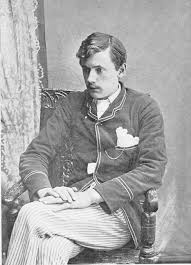 Dowson
 Wilde
Wilde
British poet Alfred Noyes (1880-1958) [LION Noyes bio], "The
Highwayman" -- Audio: read
by Noyes; setting/song by Phil
Ochs (more
on Ochs's version); animated/sung video from Britanica Dreams:
respondent: Mark
John
Masefield (1878-1967), "Sea-Fever"; Penn audio & public audio site; from Salt
Water Ballads (1902); "Consecration"
Hilaire
Belloc (1870 - 1953) and Poetry Achive bio,:"Tarentella" (1932)
[archive backup: audio & text]
also at Poetry
Archive
respondent: Lin
A.E. Housman: from A Shropshire Lad (1896): "Loveliest
of trees, the cherry now", "When
I was one-and-twenty", "With
rue my hear is laden" [word file of these three
poems): Oxford bio
Ernest Dowson (1867-1900) & wiki: "Non
Sum Qualis Eram Bonae sub Regno Cynarae" (published 1896); "Vitæ Summa Brevis Spem nos Vetet Incohare Longam" (1896) [Lee Remick recites this poem to Jack Lemmon in The Days of Wine and Roses: YouTube. This and "Cynarae" also quoted by Eugene O'Neil in Long Days Journey into Night, along with Baudelaire, see below: YouTube, though the poetry is partly cut]
Canadian poet Robert
Service's (1874(?)-1958): The Spell of the Yukon: "The
Shooting of Dan McGrew" and "The Cremation of Sam McGee" (also
avail. as word
file); Listen to Jean Shepherd recite these poems: "McGrew" & McGee". Service web site, Wiki, Oxford[registered students should be able to access these files; please let know immediately if you have any trouble. you can also find these cuts on Spotify, Rhapsody, &c.]
Extensions (optional):
Belloc: set
of poems; see esp., from A
Bad Child's Book of Beasts (1896): "The
Hippopotamus" & "The Dromedary"; also "The
World Is Full of Double Bed"
Oscar Wilde (1854 - 1900), "The Ballad of Reading Gaol." Wilde is from the previous generation to the other poets in this set, though younger than Swinburne and Rossetti and Tennyson. This is a prison poem written by Wilde in 1897–8, after his release and during his self-imposed exile in France and Italy; and published anonymously over his prison number, C33. Oxford intro. A brief commenary on the poem.
I would normally have assigned these poems after the French modernists, whose work is much more formally radical, but perhaps this way will allow for a great "shock of the new." Please keep that in mind in commenting on these poems.
• Go ahead, read the poems out loud.
• Discuss the politics of the form and prosody of these
poets, with special reference to their being part of the modernist
period. In other words, what particular political and social
concerns are addressed by each poem and how does their use of
form reflect that. How do they
"fit" in to a period of wild formal experimentation? Any thoughts
on gender issues as reflected in the poems?
•Noyes was notably anti-modernist in his attitudes toward the newly emerging radical poetry? How is this reflected in his poem (well that is apparent on the face, but still ...) and more how is his own time period reflected in spitt of what is on the face, or is it a retreat into the past? How does the poem differ from earlier English ballads? Consider this set of questions in regard to Service -- who did not necessarily express a hostility to the "new' poetry. In what way is this new world -- the Canadian wilderness -- change the nature of the ballad -- is this a more popular/vulgar ballad vs the more refined Noyes? What are the gender politics in these poems?
• Belloc was fascinated by the grammaphone. How would this
have affected his poem?
•Dowson is sometimes thought of as a "decadent" poet (see PEPP def.), though he is also became a devoted Catholicism. Why decadent (hint here)? When he write "I have been faithful to thee, Cynara! in my fashion," what fashion is that? What is going on in this poem? How would you describe it's attitude? What is the specific historical attitude to women expressed in this poem and does it represent something novel? (Those of you who read around will discover that this poem is thought to be about the 23-year-old poets love of an 11-year old? How does affect your moral sensibilities?)
• Is poetry that is entertaining or light less important
than "art" poems such as those by Yeats or Mallarmé?
• Do these poems lose their force with the passage of time?
Does that diminish the aesthetic value?
If this segment was slightly later in the course, as planned, I would ask
• How would you compare these poets to the War Poets (Owen,
Sassoon)?
•Compose one question for the seminar, based on the reading.
>>
Wreading: Acrostic chance: apply a Mac Low acrostic procedure
to one poem (see Experiments,
#8) . Comment on results
3. (Feb. 6) French Modernisms
PEPP def. "symbolism" (via library e-resources Princeton Encylopedia of Poetry & Poetic/LION (PEPP)
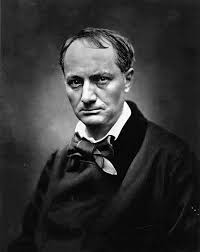
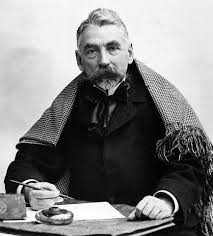
Baudelaire, Rimbaud,
and Mallarmé (LION/PEPC)

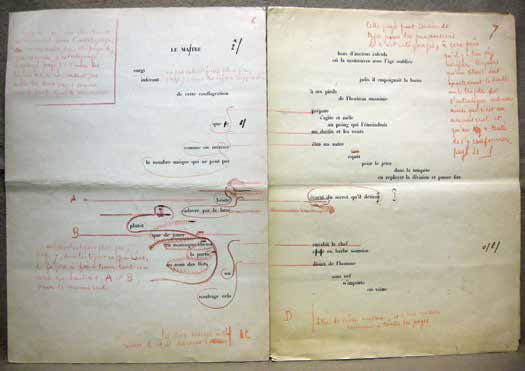
1897 first proof of Un coup
Charles Baudelaire (LION): "À
une Mendiante Rousse" (1845-6), "La
Muse Vénale" (1857): but also selections in PM1.
______ "Be
Always Drunken" tr. Arthur Symons, a contemporary of Dowson (cf.: O'Neill quotes in Long Day's Journey into Night; along with ref. to Dowson: YouTube), "Be Drunken" tr. Bernstein
respondent: Isabella
•
Stéphane
Mallarmé (1842-1898), Un
coup de dés will also be discussed in class:
_____in PM1 (both selections)
_____ "Crisis
in Poetry" (full essay) -- OR-- just read the excerpt.
respondent: Julia
•
Arthur
A Season in Hell (bilingual). See selections in PM1. "Drunken Boat": Eng / Fr
cf: "Derangement of the Senses"
respondents: Arundhati, Derek
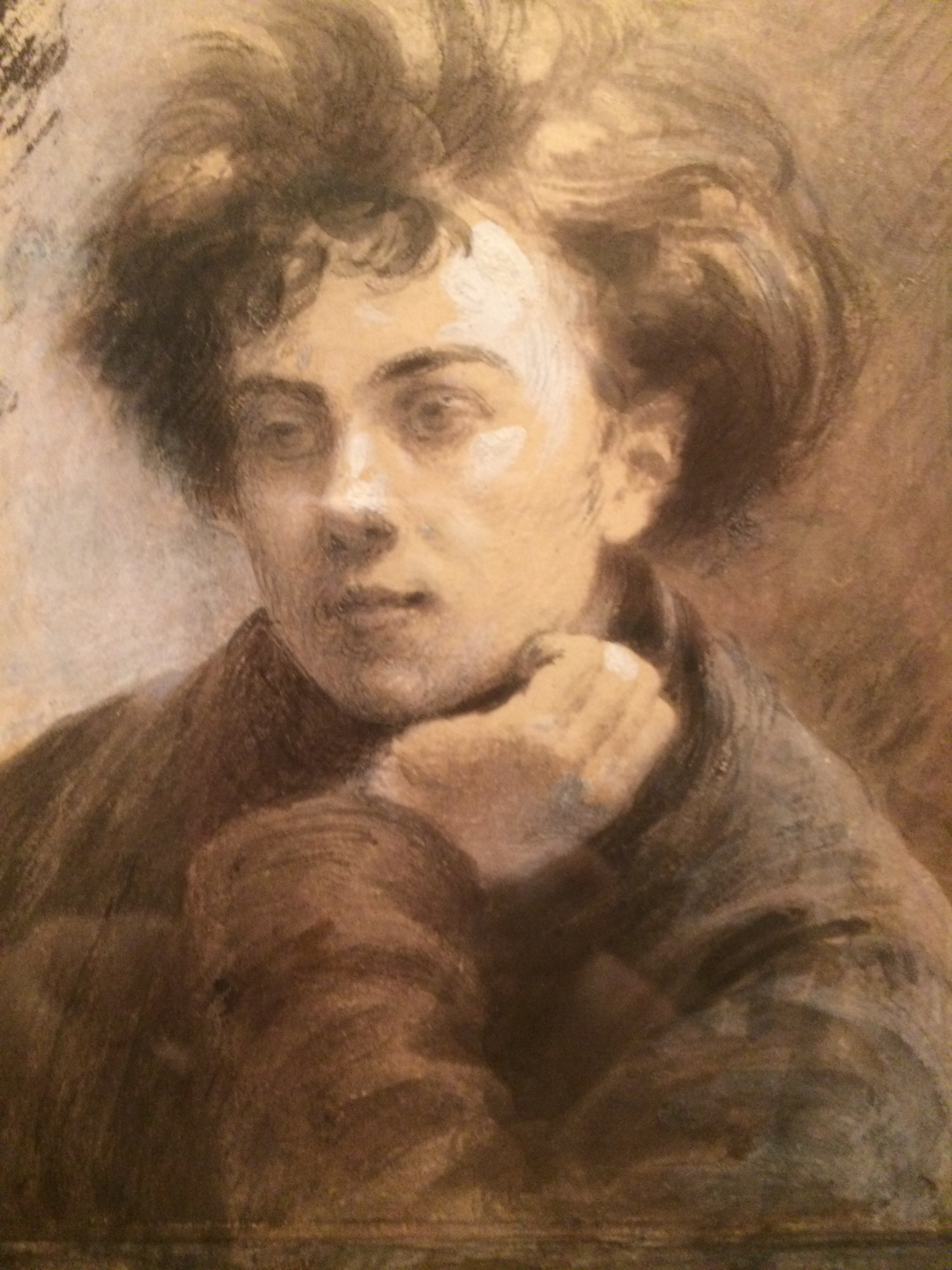
Rimbaud, study for Fanton-Latour painting
Extensions (optional):
_______ Further translations of the poem at Fleursdumal.org and
check links to complete
_______ . "To the
reader" ["Hypocrite lecteur, -- mon semblable, -- mon frère"]
______. Essays: Salon
of 1848 & Painter
of Modern Life (1863)
_______. French texts
_____, "À
une Mendiante Rousse" (tr. lined-up side by side)
_____: my tr. side by side pdf
Mallarmé & Baudelaire:
translations of Poe's "Raven"; Mallarmé's book was
done in collabortation with Manet: web version of both translation via Text-Works
• Use Poem Profiler on Mallarmé, Rimbaud, and Baudelaire
• What is Baudelaire's attitude toward the "muse vénale" (the
venal muse) and to the "mendiante rousse" (red-haired
beggar)? Does he objectify them, is he sympathetic, empathetic?
In what way are these poem "modern" (subject matter? form? attitude?)
Which translations do you like best, least & why?
• Contrast Yeats and Mallarmé and Baudelaire. Based
on your poem profiling self-test, what does this tell you about
your preferences?
•The first line of Baudelaire's "À Mendiante Rousse" is "Blanche fille aux cheveux roux." The literal word for word translation would be "White girl with hair red." Here are some of the choices the translators made: Pale redhead, Palish girl with reddish hair, Pale red-headed girl, Pale girl with fiery hair, Pale red-haired girl, White girl with red hair. Discuss!
• What for Mallarme is "pure poetry"? What is
the "crisis" for poetry? In Un Coup de dés: what
is the importance of the white space and of the layout? How would
the poem be different if it was laid out in traditional stanzaic
form (try that out to see)?
•Discuss this quote from Paul Valéry on first seeing the poem: "It seemed to me that I was looking at the form and pattern of a thought, placed for the first time in finite space. Here space itself truly spoke, dreamed, and gave birth to temporal forms. Expectancy, doubt, concentration, all were visible things. With my own eye I could see silences that had assumed bodily shapes. Inappreciable instants became clearly visible: the fraction of a second during which an idea flashes into being and dies away; atoms of time that serve as the germs of infinite consequences lasting through psychological centuries — at last these appeared as beings, each surrounded with a palpable emptiness […] There in the same void with them, like some new form of matter arranged in systems or masses or trailing lines, coexisted the Word!"
• Why does Eugene O'Neill quote Baudelaire and Dowson in the last act of Long Day's Journey
into Night. Is Baudelaire a "decadent" poet? What would Baudelaire have represented in 1912, as in the play? See O'Neill excerpt here.
•Rimbaud famous wrote, Je est un autre (I is another). Discuss this along with his other famous comments: Je dis qu'il faut être voyant, se faire voyant. Le poète se fait voyant par un long, immense et raisonné dérèglement de tous les sens.(I say one must be a seer, make oneself a seer. The poet makes himself a seer by a long, immense, long, and reasoned derangement of all the senses.)
•Compose one question for the seminar, based on the reading.
Wreading:
Try a homophonic translation of Un Coup dés (French
version linked above) (see experiments
list #2). Comment on the result.
For those who know French: try translating a poem.
Tues., Feb. 7 at 6, KWH, Tyrone Williams
4 (Feb. 13) Worlld War I & French Modernisms at the time of WW I: note two parts!
4A. The Great War
and Modern Memory
Note the World War 1 show at PAFA, directly relevant to this set of readings.

Rupert Brooke
(1887-1915), "The Soldier" (1914) (Wiki & Oxford)
respondent: Daniel
Wilfred
Owen (& Oxford WWI archive has mss) (1893-1918): "Dulce
et Decorum est", "Greater
Love", "Anthem
for a Doomed Youth" [These poems also availble via LION at library e-resources.]
respondent: Arundhati and Steve
Siegfried
Sassoon (& Oxford & WWI arch) (1886-1967): "Repression
of War Experience " and "Blighters," "Blighers" (ms), "Repression" & p. 2 (ms)
[also available at LION]
Extensions (optional):
Sassoon, audio:
"Died of Wounds" & "Attack" (note:
full Sassoon poems & bio available on LION)
Isaac Rosenberg (1890-1918), see mss; Trench Poems: "Break of Day
in the Trenches", “Returning, We Hear Larks", "Dead Man's
Dump" (LION); further reading: "God" & text
Further reading: Paul Fussell, The Great War and Modern Memory
OUP's First World War digital archive
• What are the attitudes toward war reflected in these
poems? How does this translate into the forms of the work. How do these poems contrast with earlier attitudes toward expressed in poems. Easy one: contrast Brooke to the others.
• How does World War I affect modernist art?
• Pick your favorite and least favorite poem of the poets
assigned. What is the reason for your selection?
•Compose one question for the seminar, based on the reading.
Wreading: Translate one of the poems into a totally contemporary
idiom, including references and diction. (That is, take one of
the poems and imagine you were writing the "same" poem
in 2006, with the current war and culture as your subject. Update
the references but also the language, the diction/slang etc.)
4B. French modernisms (conitnued)
Apollinaire& Cendrars (both head notes via (via LION/Columbia Dictionary)
 Apollinaire
Blaise
Cendrars, "Prose of the Trans-Siberian" in PM1; see image of
work (painting by Sonia Delaunay): overview, detail, wiki.
Alternative web-translarton
by Ekaterina
Likhtik
respondent: Carrington
Apollinaire [Guillelmus
(or Wilhelm) Apollinaris de Kostrowitzky] (1880-1918), "Zone" (1912)
in PM1; note: "Zone" in
French
____ Alcools (1913): "Le
Pont Mirabeau" (& sound files), "Clotilde," & "Annie"
____Calligrammes: Poems of Peace and
War 1913-1916 (1918): ."Ombre",
"Horse Calligramme" in PM1; "La
Colombe Poignardée et le jet d’eau" & "Lettre-Océan";
see others at UBU, but
esp. "Il
Pleut" (It Rains).
respondent: Regina, Derek
Apollinaire
on PennSound
NOTE: In class, we will focus on "Le Point Mirabeau" and
the "Calligrammes."
Extentions (optional): the remaining Apollinaire in PM1; more
Apollinaire in French & another
site,
Calligrammes(pdf of full book)
• Compare the British WW I poets to Apolinaire's response to
WWI (for last meeting) ... and also to love.
•
Discuss "Ombre" ("Shadow") and "La Colombe Poignardée et le jet d’eau," two of Apollinaire's World War
I poem, in the context of that most brutal war (looking ahead to a contrast with the UK WWI poets).
• The Calligrammes make use of visual arrangement and
typography as an integral part of the poems. How does this affect
the meaning or space of the poem. Compare to Mallarmé's
use of white space and typogrpahy in Un
coup de dés.
• How is "modernity" reflected in
form and content in the poets and what makes them differerent
from one another and from the group.
• Discuss the atmosphere or sensibility or mode of feeling
in these poems. Use poem profiler.
• How do "Zone" and "Prose of the Transiberian" usher in
the modern, new world?
•Compose one question for the seminar, based on the reading.
Wreading:
•Try some imitations of these poems. Or a homophonic translation
based on listening to Apollinaire's reading.
•Juxtapose images and words for either of the poets (or one of
the earlier poets) along the lines of Delaunay's collaboration
with Cendrars.
•Make a "calligramme." Compare Apollinaire as WWI poet with the UK poets of the "Great
War". Compare Apollinaire's "Le Pont Mirabeau" to
Dowson's
"Cynarae" — how do these love poems differ from
other love poems in the section of earlier love poems you may
have read.
For those who know French: try translating a poem.
• Comment on your experiments so far: useful?, and, if so,
in what way?
________________________________________________________________
Weds., Feb. 15 at 6, KWH, Craig Dworkin
Thurs., Feb. 16, at 6pm, KHW, Cecilia Vicuna
5. (Feb. 20) Futurisms|
Futurisms (via Princeton Encyclopedia of Poetry Poetics / LION (PEPP))
Futurism by Tyrus Miller (Blackwell Companion)
The best critical account of
the futurist and formalist poetry and art around the time of
World War I is Marjorie Perloff's The Futurist Moment.

El Lissitzky and Hans Arp, Kunstimen ("Artisms")
book cover, 1925.
5A . Futurisms Part One: Marinetti (via LION) & Italian
Futurism

Marinetti (via library e-resources Literary Encyclopedia) & related in PM1: pp. 193-215
new tr.
of Futurist
Manifesto. & my performance of "The Futurist Manifesto" and Loy's "Aphorisms" at MoMA)
respondent: Julia and Lauren
Mina Loy, “Feminist Manifesto,” “Aphorisms
on Futurism,” 1914 (pdf/Penn);
also pdf/Penn
of ms of "Feminist Manifesto)
respondent: Samantha
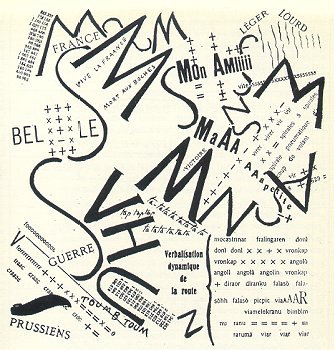
Images (Penn only: off campus requires you to log in, then refresh): "Parole
in Liberta" (1915) also nonrestricted
gif, "Vive
La France," study/drawing for "Vive
La France", " Zang
Tumb Tuuum (see Wiki on this work)
Futurist
time line; the
gang
Marinetti PennSound
page
MoMA Futurist Manifesto at 100 page.
See photo
of Luigi Russolo with noise makers & his noise
manifesto
Carlo
Carrà, Interventionist Demonstration(Patriotic
Holiday-Freeword Painting)
[Manifestazione interventista (Festa patriottica-dipinto
parolibero)], 1914
•
For further reading/listenting:
Marinetti manifestoes: "The
Founding and Manifesto of Futurism" (1909), "We
Abjure Our Symbolist Masters, the Last Lovers of the Moon" (1911-15), "Technical
Manifesto of Futurist Literature" (1912), and "Portrait
of Mussolini" (1929); "Destruction
of Syntax/Words in Freedom, "War
"; "Futurist Synthesis of War."
Futurism web site
Some more images and words
Futrurism
and advertising
Conversation
on Futurism -- Claire Bishop & Boris Groys
• Respond to the points made in Marinetti's manifesto. What
are the politics of this poetry? Why does he emphasize speed,
destruction, war, and the future?
• How is Marinetti's visual poetics different from Mallarmé
and Apollinaire?
• What is the signficance of "noise" in this work,
as for instance for Luigi Russolo?
• Once again, this is writing that comes out of the period
around World War I. Thoughts?
•Compose one question for the seminar, based on the reading.
Wreading:
Rewrite one of the manifestos for a contemporary aesthetic position
Burroughs fold-in: Take two different pages of poetry or manifesto
and cut the pages in half vertically. Paste the mismatched pages
together.
5B. Futurism Part Two: Russian Futurism
 Mayakovsky
reading: PM1: pp. 220-250
Mayakovsky images (Penn only): "A
Tragedy" designed by David and Vladimir Burliuk (1914) ; Dliagolosa
(For the Voice) (1923); Book.
For class: Khlebnikov's "Incantation by Laughter"(my tr.) and
see also alt.
translation and Roman Jakobson reading on the Khlebnikov PennSound page
respondent: Mark
plus focus on Kruchenyck/Larionov, Pomade via Expodity site at Getty (pdf earlier version of site: with
translation and audio —go to "Exlore the Books");
(Furturists other than Mayakovsky)
Mayakovsky, "Screaming My Head Off" (PM) (and listen
to Mayakovsky read this poem, see alt. title "At the
Top of My Voice"). Literary Encyl on Mayakovsky.
PennSound
Getty Futurist page of sound files..
Extensions (optional):
Russian Futurist manifesto: "A
Slap in the Face to Public Taste" (1917)
Velimir Khlebnikov (1885-1922), Manifestos ("We
accuse the older generation ...,: "The Word as Such," "The
Letter as Such"; "To
"; & at UBU, Klebnikov@RussianPoetry.net
"!Futurian," "Let Them Read on My Gravestone," "On Poetry": pdf
Kruchonyk's
visual and zaum poems; see also Gerlad
Janecek's essay on Kruchonykh's zaum poetry
Vladimir Mayakovsky (1893-1930), PennSound
audio/bilingual poems
Liabov Popova (1889-1924): Constructivist
Composition, Linear
Composition, "Spatial
Force Construction"
Alexander Rodchenko (1891-1956), Cigarette ad; "Better
Pacifiers There Have Never Been"; Mayakovsky
ad for cookies; portrait
of Mayakovsky
Russian
avant-garde books (Getty collection of digized books) and pdfs
of book
Kamensky, Tango with Cows (full book, pdf, 1914)
Sound files and scores for Russian futurist sound and poems: Baku: Symphony of Sirens: Sound Experiments in The Russian Avant-Garde
Markov's history of Russian futurism: pdf
Mayakovsky's long poem "About this" (1923) with Rodchenko's illustrations, in Herbert Marshall's English translation preceded by Bength Jangfeldt's essay and Marshall's own intro and endnotes.
• What is your response to these approaches to poetry? In
other words, discuss the forms and significance of visual and
sound poetry, and of the manifestos.
• Contrast Russian and Italian Futurism. How do the manifestos differ
in orientation. A related question:
• What are the politics of this poetry? How does it connect
with the Revolution of 1917?
• Khlebnikov and Kruchonyk developed a conception of "zaum" poetry
(transense), using invented words. Discuss this development:
is it possible to communicate with made-up words, how does zaum
relate to music and to more tradtional forms of poety. Is zaum "absorptive" or does it resist the reader's absorption?
• The Russian futurists engaged in many verbal-visual collaborations.
Describe the specific approaches they took and the significance
of these collaborations aesthetically, politically, and socially?
• A more general question: over the past weeks, you have
been readings accounts of the First World War (and now the Russian
Revolution) through poems. What is the difference between such
a poet's eye view (or ear view) and that of an historian or from
political documents of the time?
•Compose one question for the seminar, based on the reading.
Wreading: create visual or sound poems or visual-verbal poems,
or zaum (neologistic/made-up words) poems. Or rearrange/cut-up
material from this week's reading to created your own poems.
For those who know Russian: try translating a poem.
6. (Feb. 27) Dada / Schiwitters
6A
DADA (by Anna Barkin at LION from Princeton Enc. P/Poetics]
& Literary Encylopedia (or via e-resc)
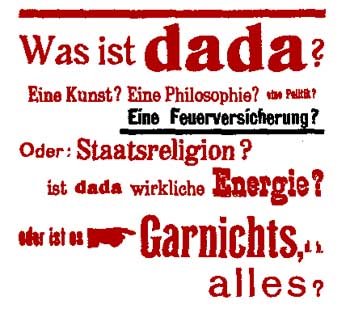

The First International Dada Fair at Dr. Otto Burchard’s
Berlin art gallery. Schlichter’s pig soldier can be seen
hanging from the ceiling, while George Grosz stands at right
with hat and cane
Reading: PM1 pp. 289-309,
746-48
Tristan
Tzara (& see Literary Ency and LION) (1896-1963)
Tzara:"Dadaism"
respondent: Regina
Hugo Ball (1886-1927) ; another bio
Photo; another
Kawane: mp3 (performed by Rothenberg) and text; Marie Osmond performance
Dada sound poems on PennSound
respondent: Daniel
•
Picabia:
Picabia poems
"Spermal Chimney" tr. Rothenberg
(extensions: Picabia books, Oxford ref.):
respondent: Selina
Extensions/Optional:
Tzara, "Dada
Manifesto" (1918)
from Tzara, "Dada
Manifesto" (1918) and "Lecture on Dada" (1922) :
also "Chanson
Dada" in French [extensions: Vingt-Cinq Poems]
Tzara's "Approximate Man" in French.
Raoul Hausmann: "The
Art Critic" (click on image to enlarge); "A.B.C.D.
Portrait of Artist", " Dada Wins!)" (1920)
Photo of Opening
of First International Dada Fair (1920), Photo
of Hausmann and
John Heartfield, "Rationalization
Is on the March" (1927), "This
is the Salvation They Bring" (1938), "Life
and Events in Universal-City at 12:05 noon"; "German
Acorns 1933"
Hannah Hoch (1889-1978), "Collage", "Cut
with a Kitchen Knife"(detail) full image.
Excellent German
lanauge Dada site.
International DaDa e-library
Joris tr. of Tzara, including "Dance of the Greased Women"
PM-Dada
• Why was this work denounced as anti-poetry: write
an attack and also a defense of the poetic/artistic value of
the work.
• Continue discussion of surface/depth from the previous
week
• How does collage operate in these works. How is collage
different in poems versus visual art (e.g. Heartfield)?
• Much of this work is highly political without making direct
political statement. Discuss the politics of form (collage, discontinuity,
performance, manifesto) in these works.
• Discuss the performances of Hugo Ball. In a more general
way, discuss the performative nature of many of these works (at
the most basic level — how does that differ from lyric
poetry that one reads privately to oneself?)
• It is sometimes said that the Dadaists tried to break
down the distinction between art and everyday life. How so?
•Steve McCaffery writes, "the condition described accurately corresponds with Ball’s general theories of primordial memory and the complex imbrications of the child and the irrational. Renouncing one type of institutional codification, Ball returns involuntarily to another: the Catholic Church. Ball predicts that in the conditions experienced in the world around him, art 'will be irrational, primitive, and complex; it will speak a secret language and leave behind documents not of edification but of paradox.' " Discuss.
•Compose one question for the seminar, based on the reading.
Wreading: Tzara's hat: Cut up the poem into individual words
(alternative: phrase, line) and put them in a hat. Reassemble
 1937: Adolf Hitler and Adolf Ziegler in front of Dada Wall at "Entartete Kunst" ("Degenerate Art"): paintings by Kandinsky, Klee and Schwitters, deliberately hung askew & below Entartete-frie art, Adolf Ziegler's painting, "The Four Elementsm" hung in a Hitler residence:

6B — Kurt Schwitters
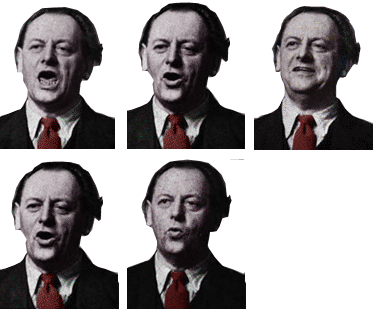
Kurt Schwitters (1887-1948) in PM1, & audio of "Ur
Sonata"
Session led by Chris Mustazza
respondent: Amey and George
Digital images: "Blue
Birds", Type
Reklame, page
of book collaboration,
"Merzbau" (Hanover, 1924), "Siebildt," "Mertzbild" "Green over Yellow" (1947), "Construction for Nobel Ladies," "Forms in Space"
See also: Schwitters's Anna
Blume(reprodiuction of German book); German text of Anna Blume; Gernam recitation of the poem
See also digital version of Schwitter's magzaine Merz
Extensions (optional) on Sound Poetry:
Steve McCaffery's brief history of Sound
Poetry at Ubu and McCaffery in PM2, p. 427
McCaffery, Carnival:
sight and sound (see IV. items 4 & 5, text and sound)
Henri Chopin, Fresque
de l'Impalapable voix (1990)
François Dufréne, "Batteries
vocales, Crirythme" (1958)
Christian Prigent, "Orgasm" (1998)
Christian Bok -- Studio
111 performance, esp. 1, 4, 6, 7 (including another Hugo Ball)
Caroline
Bergvall's "About
Face"
Tomomi
Adachi
EPC
Sound Poetry Index
Carnivocal
Ubuweb
• Compare Schwitter's, Hugo Ball, and Khlebnikov in terms
of poetics and the use of neologisms (made-up words).
• Try to do a close listening of one movement of the "Ur
Sonata," mapping out its changes and what it might suggest to you.
• It is reported that when Schwitters first performed
this, some in the audience wept? How is this possible? Is this
work conceptual, intellectual, or visceral? Run the poetry profiler
on the work.
• Do you see this as a work attacking "sense" (in
a Dadaist way? otherwise?) or making a new kind of sound-sense?
• Has poetry gone too far with this? Is this even poetry?
If this is poetry, how would you define a poem? If not, what
is this? Why isn't it music? (or is is music?)
• Compare the versions of the "Ur Sonata."
• Discuss some of Schwitters other works. Compare his poetry
to his visual art.
Wreading: Create a sound poem. If you have a sound editor: remix
the Schwitters files. Record or rehearse your own version of
the "Ur Sonata."
•••••••••••••••••••••••••••••••••••••••••••
March 6 No Class (Spring Break)
•••••••••••••••••••••••••••••••••••••••••••
7. (March 13) Duchamp and Surrealism
7A. Duchamp:
The Bride Stripped Bare by Its Viewers (Maybe)

Pierre Cabanne. Dialogues with Marcel Duchamp (1887-1968) [required text available at the Penn Book Center]
respondent: George
Duchamp in PM1
Duchamp collection at the Philadelphia Museum of Art. If you haven't seen the Duchamp at PMA, please schedule a visit before this class. Note PMA is free on the first Sunday of the Month 10:00 a.m.–5:00 p.m. and every Wednesday 5:00–8:45 p.m. is pay what you wish, so in effect free. Contact me if any problem with this as seeing the Duchamp and indeed th while PMA is mandatory but for this class and for your education in the arts!
Bottlerack/Dryer/Hedgehog (Penn image)
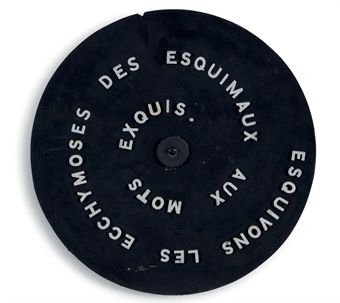
Disk
inscribed with puns & Penn image "Esquivons les ecchymoses des
Esquimaux aux mots exquis": Let us avoid the bruises
of the Eskimoes in exquisite words
& see this in context in Duchamps film, Anemic Cinema
Fountain; Penn image
Rrose
Selavy (Man Ray); wiki
Search
Phila. Museum of Art images for Duchamp
L.H.O.O.Q
Nude Descending a Staircase
Comb: PMA
image; compare New
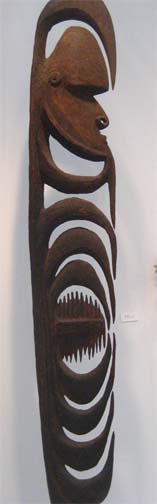
Guinea Spirit Figure
"Eyechart"
"In
Advance of a Broken Arm"
"Three
Standard Stoppages" & "A
Network of Stoppages" (1913-1914) & discussion
Apollinere
Enameled; PMA
image (better detail) (1916-1917)
Étant
Donnés, interior
view (1946-1968)
Thumbnails
of art
Extensions (optional): : interview
with Duchamp (may not work) and another
interview; Duchamp web site: Tout-fait (may
not work); Marchel Duchamp.org
Duchamp at UBU
The Writings of Marcel Duchamp, Da Capo Press.
From Marjorie Peloff's 21st-Century Modernism, Chapter
3: The Conceptual Poetics of Marcel Duchamp [ .pdf | .rtf ]
• In what way might Duchamp's work be relevant for modernist
poetry (apart from the immediate fact of his own literary work)?
Discuss in terms of both the ready-mades and the Large Glass.
• Discuss the approach to art that Duchamp takes in the
Cabanne interview: is he doing away with art or shifting the
frame of what we take to be be art?
• How does the voyeurism work in "Étant Donnést";
compare the use of the "gaze" with the Baudelaire's
portraits of woman or other poems in which this issue is relevant.
• Discuss the small fetish objects on display at the museum,
with special reference to the significance of the writing/inscriptions.
• Perloff writes, "Duchamp’s term for the all
but imperceptible difference between two seemingly identical
items was, the term infrathin, a term closely linked to
what Duchamp also called deferral or delay."
Discuss how this relates to Duchamp's work (for example his puns)
or more generally to poetry and poetics.
Wreading: Create a poem or collage based on cut-ups and excerpts
from the Duchamp Dialogues.
7B. Surrealism(PEPP/LION)
 Breton
& Eluard, seated
Breton
& Eluard, seated
Session led by Chris Mustazza
PM1 338-341, 465-485, 492-95:
André Breton, Philippe Soupault,
Robert Desnos
N.B. PM-Surrealism for display
French: "Médaille de sauvetage"
Surrealist Extensions:
Surrealism
manifestos [Penn only] & Literary Encyc
André Breton and Leon Trotsky, “Manifesto:
Towards a Free Revolutionary Art” (1938)
respondent: Kristyn
Max Ernst in PM1(pp. 506-514)
Beyond Dada and Surrelaism:
Antonin
Artaud,

Artaud via LiteraryEnc
____in PM1&2 (PM-Artaud for digital dispaly)
Artaud
sound files at UBU
respondent: Arundhati
Exensions:
"To Have Done with the Judgement of God"

The Passion of Joan of Ark (Dryer) with Artaud: not this is a silent film; the soundtrack has been added; best to watch without sound!.
• Describe visual images in two poems. What is the relation
of the visual image to the poem's theme or point-of-view?
• What is surrealism?
• Use profiler on one or more poem
• Is there a politics to this poetry?
• Do you see a connection between Surrealim and Dada or
Futurism (focusing on the poems of each movement)? How do you see Artaud in the cotext?
•Compose one question for the seminar, based on the reading.
Wreading:
Substitution (1): "Mad libs." Take the poem or other source text
and put blanks in place of three or four words in each line,
noting the part of speech under each blank. Fill in the blanks
being sure not to recall the original context.
Substitution (2): "7 up or down." Take a poem or other text and
substitute another word for every noun, adjective, adverb, and
verb; determine the substitute word by looking up the index word
in the dictionary and going 7 up or down, or one more, until
you get a syntactically suitable replacement. (Cf.:
Lee Ann Brown's "Pledge" & Michael
Magee's "Pledge" or Clark Coolidge
and Larry Fagin, On the Pumice of Morons.) If you
find this too pre-determined, remember that that may be the value,
your lack of control. However, a "liberal" alternative: pick
any one of the 7 words up or down.
Substitution (3): Find and replace. Systematically replace one
word in the source poem with another word or string of words. Perform
this operation serially with the same source text, increasing
the number of words in the replace string.
Try translating a poem.
Further Reading/French Poetry (optional):
Paul Valéry, Alfred
Jarry, Max Jacob, & Francis Ponge in PM1. [On Ubu Roi]
Valéry's
"The Cemetery by the Sea" (tr. Charles Guenther), tr. by Cecil Day Lewis
Ponge, "L'orange"
André Breton and Phillippe Soupault Les Champs magnétiques (Magnetic
Fields), 1920
Georgio De Chirico, Hebdomeros
Guy Debord on Dérive and on Détournement
Society of the Spectacle Knabb tr., Black & Red tr. by Freddy Perlman, (another site for this), Nicholson-Smith // French version // film (in French) English subtitles
Jacques Rouboud and Anne-Marie Albiach in PM2
Albiach, tr. Bernstein
Olivier Cadiot's Red,
Green, & Black, tr. Charles Bernstein and
Cadiot
The Random House Book of Twentieth Century French Poetry,
ed. Paul Auster;
The Yale Anthology of Twentieth-Century French Poetry,
ed. Mary Ann Caws
8 (March 20) Negriitude, Brathwaite / Nathaniel Mackey reading
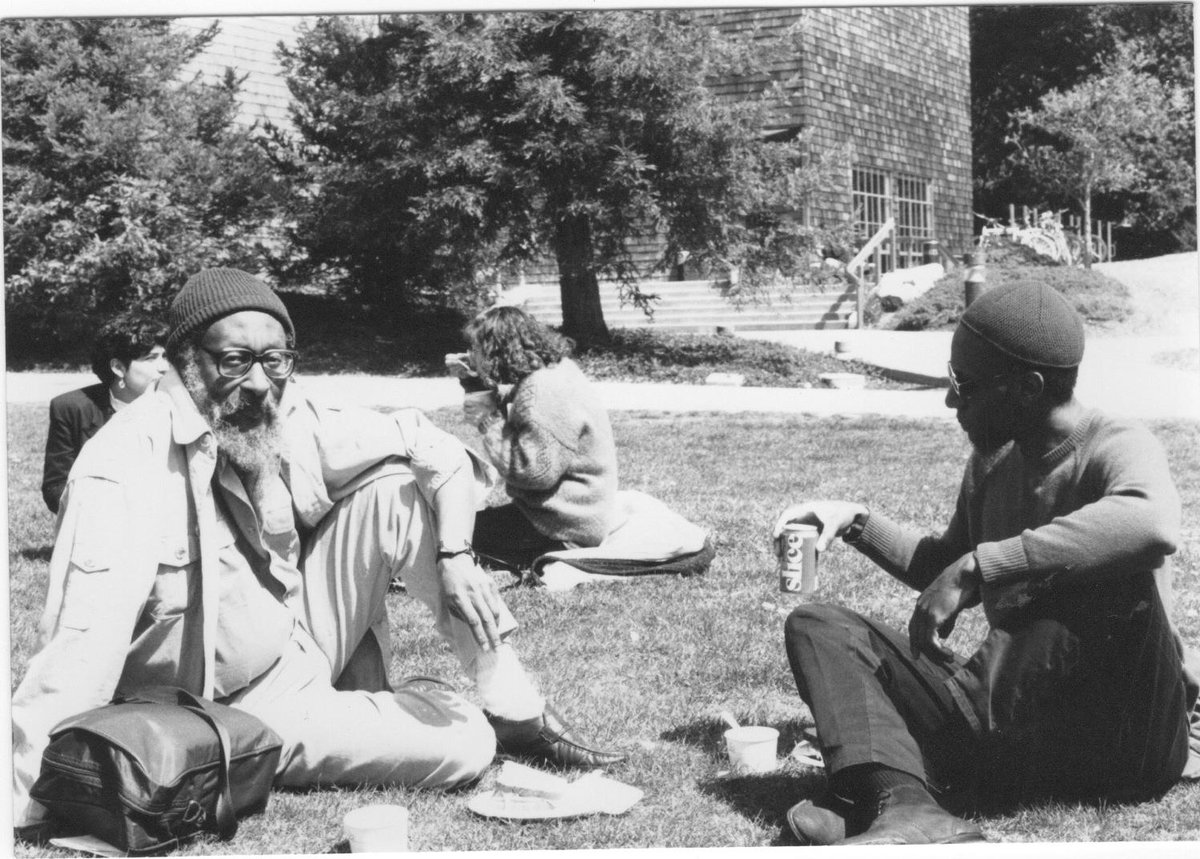
Brathwaite and Mackey
We will meet at 6:30pm at the Kelly Writers House, for the reading of Nathaniel Mackey. After the reading we will continue the class at KWH in room 202, upstairs. The class will go til 9:20. Please not changed time and location.
The syllabus reading for this week is selected to reflect poets who are important for Mackey..
Note we start at 6:30 -- one half-hour later than usual and will end a half-hour later.
Negritude: Senghor, Césaire,
Damas

Aimé Césaire((1913-2008) (bio/interview via Gale)
Senghor, Césaire, Damas in PM1, pp.559-581, 736, 751, and PM2 p. 73-4
Césaire: Five poems from Soleil cou coupé (1948), "Macumba-Word" (bilingual with glossary; Eng. tr. not very good!)
Damas: SOS, bilingual
Extensions (optional): interview; listen to Clayton
Eshleman read his Césaire translation; Césaire
in French
Respondent: Isabella
More Damas in French
Nathaniel Mackey
respondent: Amey and Maya
Nathaniel Mackey (EPC page)
PennSound;
of specific interest here, beyond the Close Listening show, is the relation of "Chant des
Andoumboulou"("Song of the Andoumboulou"), at end of PennSound pages, to
Mackey's poems of this title.
Note: go via library e-resources Project Muse to get the special issue of Callalloo & other essays on Mackey (see esp. Mackey issue and Brent Edwards essay): these articles are listed on EPC page but must be accessed via library Muse pages.
Mackey interview at Contemporary Literature (2012)
Nathaniel Mackey on duende, "Cante Moro" (note we will read Lorca next week, but read this now ahead)
Kamau Brathwaite (LION intro)
PennSound
"Blues' "Caliban" "Harbour"(from Black + Blues, 1995 via LION); "Kumina"; "Wings of a Dove": text, audio on PennSound (Segue); see also (extenstions/optonal) poems here.
• Pick your favorite and least favorite poems since the
last time you made such a list. Give reasons for your selection.Use
profiler.
• Contrast the poems read today with the poems from the
past two recent classes -- Surrealism and Lorca/Artaud, allowing
the strong connection between the two.
• Imagine Damas's "SOS" was written but a white women from
the midwest. Would that change the meaning of the poem?
•Compose one question for the seminar, based on the reading.
Wreading:
• If you know any French, try a bit of tranlsation of Césaire
• Negation/Opposites: Negate every phrase or sentence in
the poem or in some way substitute opposite words for selected
words in the source text: "I went to the beach" becomes "I went
to the office"; "I got up" becomes "She sat down"; "I will" become "I
will not"; etc. As an alternative, take a poem and change what
it says line for line or phrase for phrase; not opposite, just
different.
9 (March 27)
9A. Expressionisms

Munch via Literary Encylopedia, "The Scream" (Norway, 1893)
Federico García
Lorca (1898-1936)
respondent: Regina, Samantha
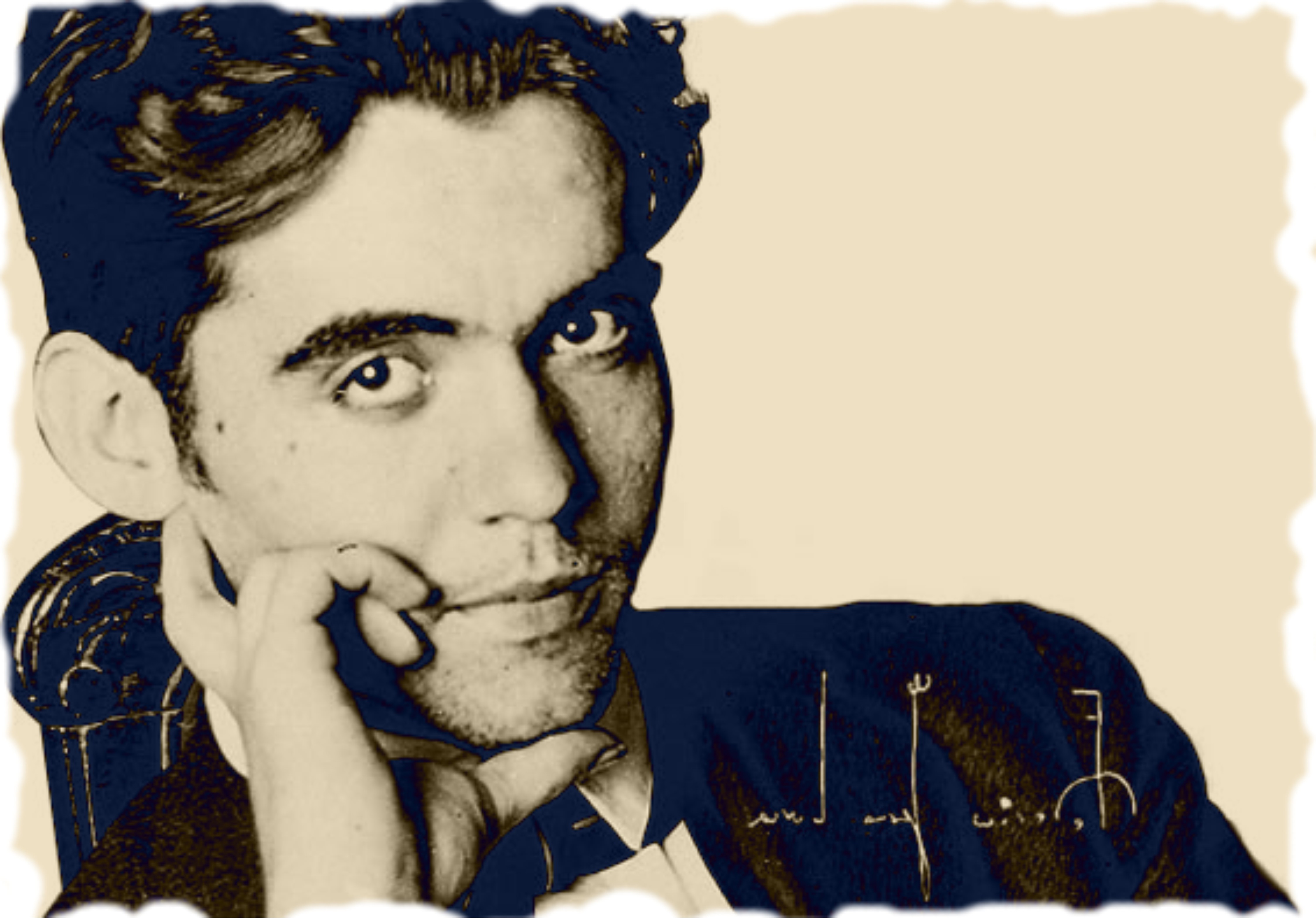
Lorca in PM1 (note: "Ode
for Walt Whitman" in Spanish and Spicer's tr. online, also here; a web selection of Lorca ;"Ode to Walt Whitman" (tr. Bellit, Poetry Fdn)' "Dear Lorca"
Lorca on "The
Theory and Function of the Duende" (c. 1933)
Nathaniel Mackey on duende, "Cante Moro"
Lorca tr.
by Paul Blackburn (bilingual)
German Expressionism
PM1: pp.263-265
Lasker-Schuller, "To the Barbarian" (p.
270)
Benn & Trakl (pp. 277-285)
Rainer Maria Rilke & intro (LION) (born Prague, 1875-1926)
in PM1 (2 selections)
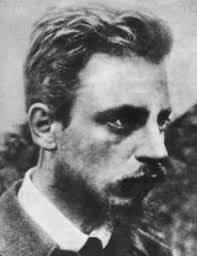




In class we will focus on Rilke
Duino Elegy #1; see notes by Bernstein and Perloff (just
the beg. of the Perloff essay)
from Book of Hours (c. 1899)
"Torso
of an Archaic Apollo"
respondent: Carrington, Lauren, Selina
Extensions (optonal):
"Duino
Elegies" (bilingual, multiple translations); Rilke
in German; "Letter
to a Young Poet,"Elsa
Lasker-Schuller
Benn: "Little Aster" in German; more poems
Benn audio
Some related images: Edvard Munch, "The
Scream" (1893), "Anxiety"
Optional: art background: Paul Vogt and Ita Heinze-Greenberg. "Expressionism" (pdf), Oxford Art Online.•
• Pick your favorite and least favorite poems (from the course) since
the last time you made such a list. Give reasons for your selection.
• Are these poets -- the ones assigned for this unit -- more expressive than the other poets,
or is that the approach to expression is different? What does
each poem "express"?
• Expressionism is sometimes understood in terms of depth
rather than surface; yet Rilke might be said to be depthless.
Discuss the surface/depth distinction in terms of the poems.
• Pick two poems and give a brief summary of their content.
How is this summary different from the poem?
Wreading: Reverse the order of the poems, line for line or run
the whole poem backword. Next: don't reverse but scramble. Comment
on result.
Try one of the translation experiments or try to do your own
word-for-word translation.
Try translating a poem.

• Pick a poem of each poet give a brief summary of its content,
taking into account the way the form suggests content in these
works. In other words, treat the form and style as part of the "content" for
the purpose of answering this question.
Wreading: Lexical translation: Take a poem in a foreign language
-- "Ode for Walt Whitman" -- that you can pronounce but not necessarily
understand and translate it word for word with the help of a
bilingual dictionary. (Rewrite to suit?).9B Mother
9B. Russia, Father USSR: Russian Poetry (in/around/after Futurism)
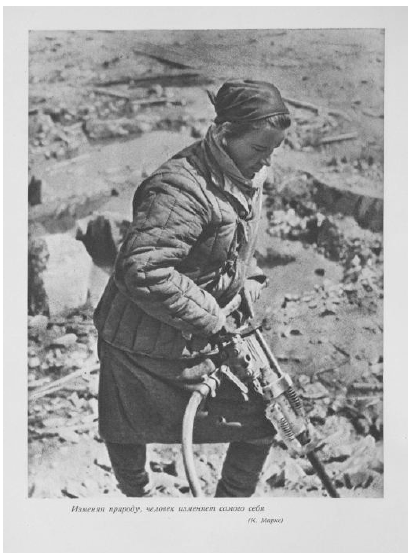
from M. Gor’kii et al, eds, Belomorsko-Baltiiskiii Kanal imeni Stalina ([Moscow]: OGIZ, 1934) [from An Account of the Construction of the New Canal between the White Sea and the Baltic Sea]; photo poss. by Rodchenko. Thanks to Joshua Kotin.
video of Nadezhda Mandelstam talking *in English* about Osip Mandelstam from around 1973: YouTube.
•Osip Mandelstam (Gale) & Acmeism (PF intro)
Respondent: Arundhati
Mandelstam in PM1: pp. 390-397; Four Mandelstam poems (Penn only): English & the poems in Russian; 2 poems tr. Yankelvitch/High (read note on poems too); the Stalin epigram, (another tr.)
Clarence Brown on this poem via JSTOR)
"Acmeist Manifesto" (JSTOR) (1917) (PEPP & Literary Encl) on Acmeism)
Mandelstam reading "Gypsy Girl": MP3
[Optional reading: "Conversation about Dante"; also: "Octaves," Cigale tr.; Kline]
Poems at PF
Mandelstam audio
•Marina Tsvetayeva in Literary Encl & in PM1
•Anna Akhmatova in PM1; Akmatova audio; Akhmatova@RussianPoetrey.net; "To the Muse" 1924: mp3
•Danill Kharmes & Literary Enc (1905-1942): respondent: Daniel
Intro/CB,
The Blue Notebook UDP & pdf Blue Notebook
Alex Cigale's tr., poems, "31 plays," another site
More Kharmes
•Vvedensky, The Gray Notebook.
EXTENSIONS (optional)
Arkadii Dragomoshchenko in PM2
Jacket2 obit
wiki
ATD on PennSound
Dragomoshchenko in 99 Poets/1999
PIP bio and tr. by Genya Turovskaya
"Sentimental Elegy" from Description, tr. Lyn Hejinian and Elena Balashova (Sun & Moon Press,1990)
Hejinian/Dragomoshchenko dialog via Jacki Ochs's Exchange (Bomb, 1994; JSTOR)
PMC symposium (1993) & AD's "Phosphor"
from Dust and another section at Google preview on Dalkey Archive Press page for book.
on Creeley
99 Poets
selected poems
A fuller context for Dragomoshchenko's work would include his fellow Petersburg "metaphysical" poet (as this semi-underground group was called), Alexei Parshchikov. In constrast, there were the "Moscow Conceptualists," in particular and Dmitri Prigov and Lev Rubinstein.
•
Dmitri Prigov
bio
PennSound
Jacket poems
interview
Edmond on Prigov
Versographies,
•
Lev Rubinstein (born 1947):
Jacket
my commentary
Stack version of Rubinstein's cards
•
Alexei Parschikov (1954-2009)
Arkadii Dragomochenko on Parschikov
"If I'm to Peddle Stories" (Penn only 99 Poets / 1999)
Chamblis-Ostashevsky-tr_2009 (Penn only)
Dalkey Anthology, tr. F.D. Reeve (pp. 180-189)
"Oil"
Platt/Perelman draf tr. (Penn only)
•
Elena Shvarts (1947-2010, Leningrad/St. Petersburg)
Stephanie Sandler on Shvarts
Guadian obit
Poems:
from Dalkey Anthology, tr. Margo Shohl Rosen, pp. 35-41
Memorial Candle
Conversation with a Cat
A Child in the Ghetto Surrounded by Letters
Translated by Stephanie Sandler
Free Ode
A Portrait of the Blockade
Translated by James McGavran
•
Alexander Skidan (1965- )
The Resistance of/to Poetry (99 Poets / 1999)
from Red Shifting (Ugy Duckling Presse)
Forward interview
Skidan PennSound page, including Close Listening show with him.
"Poetry in the Age of Total Communication" (Nypoesia temp. down; if so try this)
•
Pasternack reading "Night" MP3
•Do you see a common approach in Mandelstam, Tsvetayeva, and Akhmatova? The work is often thought of in terms of fate or politics, but how about the form? How does this work relate to Russian Futurism and to the French ("Symbolist") poets you've read so far? Does the work relate to Dada, surrealism, or expressionism? Is it more radical or conservative (and what criteria elicit for these characterizations)? Mandelstam addresses this in his Acmeist Manifesto: how do these poems reflect the views in that manifesto or how does he distinguish the work from Symbolism and Futurism? Is it significant that Mandelstam is Jewish?
•Is Kharmes comic, ironic, tragic, mystical?
•Dragomochenko is a contemporary poet, but do you see connections to the earlier Russian poets, for this week or the Futurists? How would you describe his sensibility
•Compose one question for the seminar, based on the reading.
Wreading:
Recombine or reorder the lines within a Dragomochenko poem.
Recast one of the modernist Russian poems into something that refers to your own life.
Try translating a poem
10 (April 3) Our America
 José Marti
Introduction
by Ernesto Grosman (from 99 Poets/1999)
The Americas -- Wikepdedia; short poet bios
José Marti (Cuba), "Our
America"
Rubén Dario (Nicaragua & beyond) (Félix
Rubén
García
Sarmiento, 1867-1916): "To Roosevelt"; poem in Spanish (PM1) & another tr. ; poems in
Spanish; "Azul"
respondent: Kristyn
Vicente Huidobro (Chile) (wiki bio)
(note in two places in PM1):
"Altazor" canto VII (1931)
performed by Jaap Blonk: MP3; performed by Juan Angel Italiano: YouTube; performend by Ch. Bernstein
Spanish: "Arte
Poetica" / "Ars Poetica" (tr.) (1916), Altazor" & pdf of 1931 pub; more VH here; another VH site
"Cow Boy" and it's appearance in French in Tzara's Dada (1918)
César
Vallejo (Peru) (PM1), from Triilce [Trilce in Spanish], [other poems
in Spanish] (also see Lit Ency)
•
Nicolàs Guillén (Cuba) (PM1) (Lit encly bio);
excerpts The Daily Daily
poems
in Spanish
"Sensemaya" (tr. Langston Hughes), bilingual pdf; wiki commentary; Silvestre Revueltas 1937 orchestral (wordess) version of the poem via YouTube – Gustavo Dudamel and Leonard Bernstein; see also Sid Robinovitch's choral version with its intense rhythmic chanting on YouTube; in sharp contrast Vivienne Barry's claymation verison with musical setting by Horacio Salinas: Vimeo
•
Pablo
Neruda [Neftalí Ricardo
Reyes Basoalto] (1904-1973) (Chile) (PM1)
also "Ode
with a Lament"; optional: poems
in Spanish; "Explaining
a Few Things" (bilingual)
Poetry Fdn, Poets.Org
respondent: Isabella
Maria Sabina (Mexico) (PM1 & PM2); Henry
Munn on Sabina
respondent: Maya
Sabina documentary (with her singing in beg.) & part 2; Rothenberg performs Sabina: MP3, Anne Waldman's "Fast Speaking Woman" based on Sabina: MP3
Smithsonian CD with stream excerpts
Cecilia Vicuna (Chile/US)
(PM2 selections)
respondent: Steve and Selina
Jorge Santiago Perednik, "Poetarzan"
Further (optional) reading:
Subcommander Marcos et al, ch. 14, Fourth Declaration Lacandon Jungle, 78ff.
Roberto Tejada, In Relation: The Poetics and Politics of Cuba's Generation-80
Oliverio
Girondo
Juan Luis Martinez from "La Nueva Novela", intro
Octovio Paz, poetry fdn
• Discuss Marti's "Our America" in the context of these
poems
• Does it make a difference that these poems were written in
Latin America? What would happen to the poems if you thought they were
written by a European or North American?
•On Huidobro, "Ars Poetica": The last two lines of the first stanza evoke “creation” — which is after what a God does as well as “invent new worlds”. This poem could be seen a sort of inaugural work of Latin American modernism. Might the “museum” be a response the “Futurist Manifesto” a few years earlier. If so, what is the attitude to museums? What do you make of the very striking line “We are in the age of nerves.” As for the roses in the fourth stanza, this brings to mind Stein’s 1913 “rose is a rose is a rose” Not to sing of roses but to let the poem be a rose. How ‘bout that? Why “little” (pequeño) God?
• Discuss the use of myths and other "fourth world" features in these poems (e.g. relation to indigenous cultures, cultures that do not use writing systems, non-"Western" cultures).
• Pick your favorite and least favorite poem of the poets
assigned. What is the reason for your selection (use Profiler)?
• Compose one question for the seminar, based on the reading.
Wreading:
• Try any of the translation exercises: lexical or homophonic
if you don't know Spanish & if you do know Spanish, do a translation.
• Eliminate all personal pronouns or self-reference in a
poem.
• Write a version of one of these poems translated into
a contemporary social/historical situation
11 (April 10). A Few Brazillian Poets
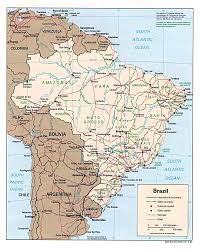
Language map (numbers are Portuguese spearkers), global languages
Carlos
Drummond de Andrade in PM1, "The Dirty Hand" (pp.
657-58)
_____, "In
the Middle of the Way"
_____, "In
the Kingdom of Poetry" in John Yau's free adpation and with Portuguese orginal; "Procura da Poesia," 1945: discussion and translations here.
_____, "The
Bomb"
further reading: More Drummond, including "The Dirty Hand" from PM2
respondent: Kristyn and Steve
Haroldo de Campos in PM2
my intro
____ "Circuladô de Fulô," with music by Caetano Veloso: YouTube with Veolso and text [MP3 (alt.
file in protected folder)] & Veloso on concrete poetry (NOTE: the format is prose for original and translation). Text of
______Three
concrete poems at UBU
___"Galaxias" & note: full book
respondent: Carrington
Décio
Pignatari, Bebe Coca-Cola (1957); more at UBU
Noigandres (Augusto de Campos, Decio Pignatari and Haroldo de Campos), “Pilot Plan for Concrete Poetry” (1958)

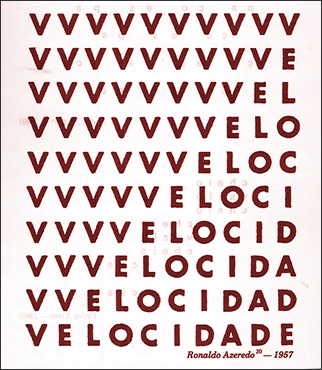
Ronaldo Azeredo, Velocity (one more concrete poem)
Régis Bonvicino, "Blue
Tile", "Prose," PennSound
audio #s4 (Talvez) & Close Listening show, 7 (Me Transformo),
14 (Where), and 16 (Blue).
João Cabral de Melo Neto (1920-1999): Three
poems
Paulo Leminksi: untitled
poem
Cruz e Sousa (Afro-Brazillian, 1862-1898) -- aka the Brazillian Baudelaire / Symbolist. from Ultimo Sonetos (c. 1900) : "Sacred Hate" (1905) (my tr.) & "Odio Sagrado"
Extensions (optional):
Josely Vianna Baptista, one
poem from 99 Poets/1999
Carlos Drummond de Andrade in PM1 (remainder); also three poems (bilingual)
Statements on Brazilian poetry from 99 Poets/1999 by de
Campos and Bonvicino
De Campos: Selection of Poems; Charles
Bernstein on de Campos, Roland Greene on
de Campos; Galáxias
site. Sound
file: Calcas
Cor de Abobora
Marjorie Perloff, "Concrete Prose": Haroldo de Campos's Galáxias and After
Mary Ellen Solt on
Brazillian Concrete Poetry
Oswadd de Andrade (1890-1954):
my intro
"Manifesto da Poesia Pau-Brazil" (Brazil Wood Manifesto) (1924): free pdf
Anthropophagite
Manifesto ("Manifesto Antropófago") (1928) anothter
tr; also Mary
Ann Caws tr.; Leslie Bary's tr with full glosses (JSTOR & same & with facsimile
Haroldo de Campos of Anthropophagy: JSTOR
Prescursor: Sousandrade (1832-1902"Wall Street Massacre" with notes by De Campos bros.: JSTOR; tr. Robert Brown; tr. by Odile Cisneros
*
Caetano Veloso: a few songs (restricted access)
Jorge de Lima in PM1
*
Deformation: Use the "Meaning
Eater" engine to deform the text of
a poem. Use a sound editor to scramble, resound a sound file
of a poem.
• Write in some detail about two or three poems. Detail any literary
"devices" used (see Profiler).
•On "Kingdom of Poetry" compare Yau's ending in his adaption with my more literal version and then Nist:
Notice:
eras of melody and conceits --
they take refuge in the night, the words
Still damp and impregnated with sleep,
rolling along the difficult river and transforming into scorn
JOHN NIST:
Please note:
Barren of melody and meaning,
The words have taken refuge in the night.
Still humid and saturated with sleep,
They roll in a difficult river and turn themselves
into despising.
Repara:
ermas de melodia e conceito
elas se refugiaram na noite, as palavras.
Ainda úmidas e impregnadas de sono,
rolam num rio difícil e se transformam em desprezo.
12. (April 17) Dialects
12A, Part
One: MacDiarmid and Bunting
Hugh MacDiarmid (via Gale) (1892- 1978) & Synthetic Scots
 MacDiarmid by Robert Heriot Westwater
MacDiarmid: Selection and note in PM1 and poem in PM2; then
go to selected
poems for "Watergaw" listen to audio at PennSound or poem/text at
Poetry Archive (photo of a watergaw); then for Drunk
Man Looks at Thistle, follow
first 100 lines with audio at PennSound; which also has audio for "British Leftish
Poetry 1930-40," "The Kind of Poetry I Want," and "The Glass
of Pure Water" (in PM2).
Full text of MacDiarmid at LION.
*
Basil Bunting (via Gale)
Basil Bunting in
PM1: Opening lines of Briggflats & audio; audio at PennSound. (Video starting on l. 118). Extensions:
full text of the poem is available on LION (library/e-resources;
quick search: "Bunting Briggflatts". Also: Poetry
Archive has an excerpt from part 1, text and streaming-only
audio. More audio of Briggflats (Penn only): part 1, part 2, part 3, part 4 on PennSound, part 5
with harpsichord, begins 5'20" (from line 53 on part 4 of text)
b/g: Share on Briggflatts
Extensions: MacDiarmid, "Revolutionary
Art of the Future"; Bio
and additional audio (Penn only); Monty Python: Poet McTeagle
Extensions (optional): Tom Leonard at PennSound: "Six O'Clock News" from Unrelated Incidents (& video) "Glasgow Poems," and comment, YouTube with Bill Griffiths
Extensions: David Jones
• Discuss the audio recording: how does it compare to the
printed text?
• What are the political implications of MacDiarmid's forms?
• MacDiarmid calls his language in "Drunk Man" "synthetic"
dialect. What does he mean by "synthetic"?
Wreading:
Convert one of the poems from the syllabus into your local dialect
Write a standard English translation of one of dialect poems

12B, Part Two Dialectic of Dialect:
Jamiaca

This set of readings extends from the MacDiarmid,
so feel free to go back and forth between MacDiarmid and Bunting
(who were friends and contemporaries) and Bennett and Smith and
McCaffery.
session led by Chris Mustazza
Louise
Bennett,"Bans
O' Killing" and "Colonization in Reverse"; audio
of "Colonization" (extensions: "Dutty Tough" audio). Litalive Bennett page.
Michael Smith (sound files)"It
a Come" and " Mi
C-Yaan Believe It": text (short bio).
respondent: Maya
Extensions/optional:
Linton Kwesi Johnson: Sonny's Lettah (text) & Fite Dem Back (text)
John Agard, "Listen Mr. Oxford Don ": video
Steve McCaffery, "The Kommunist Manifesto or Wot We Wukkers
Want": mp3 & text.
This is a translation into Yorkshire dialect of Marx & Engels' Communist
Manifesto
• Discuss the formal, stylistic, sonic, prosodic, ideological,
nationalistic, and political implications of these works.
• (Bennett:) Is humor an appropriate ingredient for serious
poetry? Some might say that Bennett is a popular performer not a significant poet. Does it make sense to include her on this syllabus, along with another Caribeean poet of polymathic range such as Césaire?
• Is this minor literature (in Deleuze and Guattari's sense)?
(For those who may know their book on this subject.)
• Compare MacDiarmid and Bunting, or Bunting and Smith
• Listening to additional cuts of Smith: what is the connection
between his "dub poetry" and
Reggae, or, to ask this another way, what is the relation of
the poems to the songs?
Wreading:
Use the dialect engine to
translate poems from the syllabus into one or several "dialects."
Or do this just by the accent you give in reading the work out
loud.
Create standard English versions of some of these poems.
Further readings/listenings: Kamu Brathwaite
April 20, Rachel Levitsky at KWH, 6
13. (April 24) Last Class
We will meet at 6 at the Kelly Writers House, Room 202, and then all go to the reading of Lydia Davis at 6:30. After the reading we will continue the class at KWH in room 202, upstairs. Please note location. Class time is the same!
Note we start at 6:30 -- one half-hour later than usual and will end a half-hour later.
13A, Part One: Exile: Turning without Return

Paul
Celan (& Gale bio):
respondent: Samantha
PM2
(three entries)
"Todesfuge" audio
(and other poems); Rothenberg tr. & (commentary); wiki
Joris's Celan selection
Sprachglitter (optional: commentary)
Sound files: protected.
Unrestricted
source for Celan sound files and poems: easier to use!
Charles Bernstein, "Celan's
Folds and Veils" (from Textual Practice 18:2,
2004) on
"Todtnauberg"
•
EXTENSIONS (optional):
Jabès, Adonis, Darwish, in PM2 Adonis & Darwish in 99 Poets Abdelwahab Meddeb in 99 Poets
Celan Extensions (optional):
pdf: "The Meridian" (1960), "Conversation in the Mountains" (1959), Breman prize speech (1958), tr. R. Waldrop; (note the book) (supplemental: outakes from the speech) & excerpts from the drafts.
Joris on Celan; Joirs interview on Celan
Joris on Celan (YouTube of Harvard lecture)
Joris on "Todtnauberg" (essay)
Extensions/futher reading (optional):
Gilles Deleuze & Felix Guattari, from Kafka: Toward a Minor Literature (pdf)
• How do these poets respond to exile? What's poetry got
to do with it?
• What is Celan's relation to his "native" language
or "mother tongue" and
his other languages? In what way is Celan's relation to German
expressed in his work?
• How does the sound-shape of "Todesfugue" relate
to its meaning?
• Is my Celan essay over-reading?
• Use the poem profiler on Celan
•Compose one question for the seminar, based on the reading.
Wreading:
Try some homophonic translations of "Todesfugue"
Re-order "Todesfugue": lines in reverse direction; reverse
direction of the words. Erase half the words to create another
poem.
Homolinguistic translation: Take a poem and translate
it "English
to English" by substituting word for word, phrase for
phrase, line for line, or "free" translation as response to
each phrase or sentence.
13B
Auden, Sitwell, Larkin, Thomas
Auden; Sitwell in PM1
W.H. Auden (poets.org) and PF bio
"Musee des Beaux Art" & wiki & audio
"In
Memory of W.B. Yeats" & audio
"The Unkown Soldier"
"Stop All Clocks"
respondent: Mark
•
Philip Larkin, "This Be the Verse" and "High Windows"
respondent: Lauren
•
Dylan Thomas, respondent: Amey
"Do Not Go Gentle," "Refusal to Mourn": sound files for Penn; or YouTube/Gentle & YouTube/Refusal: See also John Cale's version:
•
Sitwell: 1959 interview
Facade: audio (Penn only); from Facade
20 Poems: audio for "Still Falls the Rain"
We don't have the time to discuss these poems in the last class. But they are meant to bring the course full circle: back to English and to more trandtional forms. Please provide commentary on two of the poem.
On Your Own -- here are a numbr of furthr reading to expend the course on your own
Identities:
Case Studies
Samuel Beckett
in Literary Encl
PM2
"Imagination,
Dead, Imagine" (Penn only) or public
site
"Lessness"
audio of Beckett reading from Watt (1965)
Monique Wittig,
Wittig
("Le Corps Lesbien") in French original
Dubravka Djuric, "Post-Communist
Poetry" from 99 Poets/1999
___, "Disordering" & other
poems (translationa follows original)
Nicole Brossard
"Figure"
"The Throat of Lee Miller," from Museum of Bone and Water
>her reading of the poem at PennSound: "Le Cou de Lee Miller" (3:31): MP3
Brossard in PM2 (note volume 2!!)
"Poetic Politics" (Gale) in The Politics of Poetic Form
Brossard
in 99 Poets
How(2) Brossard interview
Extentions (optional):
Janice Williamson interview of Brossard: Gale
Brossard at PennSound
Fred Wah
Pictograms from the Interior of BC (start with opening 20 pages, read on as possible)
Wah Close Listening interview MP3 -- on his PennSound page (and optional listen to more there)
• Use the Poem Profiler to describe the mood, psychological
state, and other features of several poems.
Wreading: Cut-ups: take lines from these poems for this week
and re-order them into a new poem. Larger project: do a cut-up
from all the poems we have read so far
Wreading/Dicussion:
Here is Wikipedia's definition of ekphrasis: "Ekphrasis or ecphrasis is the graphic, often dramatic description of a visual work of art. In ancient times it referred to a description of any thing, person, or experience. The word comes from the Greek ek and phrasis, 'out' and 'speak' respectively, verb ekphrazein, to proclaim or call an inanimate object by name." To some extent, both Wah's and Brossard's poems are ekphrastic. Think about their versions of ekphrasis and compose an ekphrastic poem. Choose one part of the definition, and exaggerate it in your experiment. Try to make it so extreme that anyone could guess which part you've chosen.
Here are some questions on each:
Brossard:
- Who is Lee Miller? How does knowing about her, or knowing what she looked like change your interpretation of the poem?
- Describe the form of this poem. What is the most important formal "unit" in it? The line? The page? Something else?
- Related question: describe the use of repetition in this poem. How do the repeated items develop and change as the poem progresses?
Wah:
- Describe the relationship between the images and the text. Who is/are the speaker/s? - What kind of tone do these poems have? What other texts would you compare them to? What cultural or literary sources do you think this language comes from?
- Read this short blog post by the poet Gary Barwin and respond: Barwin suggests "a new 'translation' of Wah's book in light of the new understanding, the changed relationship with Native history," the possibility that "a Native writer will write a book 'transcreating' images from non-Native imagery" or "non-First Nations' writers ... rewrit[ing] the book using non-First Nations pictograms." What do you think?
All material for this class should be handed in by the Sunday following the last class. If you plan on submitting work after that time, please email; extensions are possible. For those who might like to do supplemental work for the class: by all means, expand on subjects already approached or pursue any of the "extensions."NOTE: supplemental work is not required for the course.
Extensions: Alan Golding on PM
PM launch reading at KWH on PennSound
Chinese Poetry
2008 Visit
of Li Zhimin
PennSound page
Reading:
Li Zhimin -- KWH lecture on Chinese & Western poetry, published in Internationa; Literary Quarterly, 2010.
Mao Zedong (1893-1976), selected
poems; notes; collected poems
Xu Zhimo (1897-1931), Ji Xian (b. 1913), Gu Cheng (b. 1956): pdf
from Michelle Yeh anthology.
"Mity Poets" PM2 pp. 752-769, esp:
Bei
Dao (b. 1949), "The Answer" and Bei Dao in Jacket;
Haun Saussy on Bei Dao's "Huida/The Answer" and
Tiananmen Square
Mang Ke "Apeherd" (PM2)
Gu Cheng (in Yeh
pdf above)
Shu
Ting in PM2 and also her work in the Michelle Yeh anthology: pdf
here
Language/Original poets:
Yunte Huang, Intro;
Original
Manifesto;
Huang Fan (b. 1963), "Poetry's
New Shore,"
Che Qianzi (b. 1963), "Flower
of Two Persons" (1990);
Yi Cun (b. 1954), "A
Poet's Remark on a White Bird in Winter"
Yunte Hunag, from SHI
Ma
Lan, selection
Xu Bing: "Art for the People" (flag reads as English) & "New English Caligraphy" & images (Square word calligraphy), "Your Surname Please"
Xi Chuan and here
Yao Feng
Li Zhimin -- a selection and
in Chinese
Chinese + American poets reading at St. John's Cathedral in NY, 2015, for Xu Bing's "Phoenix" and with Bei Dao.

• Mao is considered one of modern China's greatest
poets: how is his role as a major (and, to put it mildly, troubling)
political leader and revolutionary reflected in his poetry? What
role does poetry play in his political leadership? Is there a
conflict between being a lyric poet and Mao's political ideology
and actions.
• Discuss Huang's approach to translation, taking up our
discussion of translation in the second class.
• Compare the "Misty," "Language/Original
Poets," and Li Zhimin. Do a close reading of a poem from
each group, perhaps using the poem profiler. Discuss the politics
of poetic form in the poems (how the chosen forms reflect political
or social perspectives).
• Li Zhimin will be talking about the influence of Western
poetry on modern Chinese poetry. One example (somewhat negative
in his view) is Xu Zhimo's idealization of Cambridge Uniiveristy,
But the influence is reflected in the selection of contemporary
poets. What qualities in these poems reflect a distinctly Western
and also a distinctly non-Western approach to poetry?
Wreading:
Write imitations of a couple of the poems in this week's reading.
In other words, change the subject or place but write a poem
in a manner as close to the "original" as possible.
For those of you who know any Chinese at all: do new translations
of the poems for which the Chinese is provided
As a final post, please give your response to the course, focussed primarily on the poetry and poetics, but also the class and listserve discussion of the poetry and poetics, the web-based syllabus, PennSound, and the wreading experiments. Chart changes in your thinking about poetry and poetics from before the class began to now. Thinking back on
all the poems read and heard, discuss/revisit some of the work that stays with you the most. If you were to change any part of the syllabus, what would you change? One final question (after Robert Duncan) and specifically
in respect to the focus of this course: What don't you know?
What would you like to pursue?
BONUS TRACKS
Concrete
and Visual Poetry
PM2: pp.304-316
Concrete
and Visual Poetry selection
Williams Concrete Poetry anthology
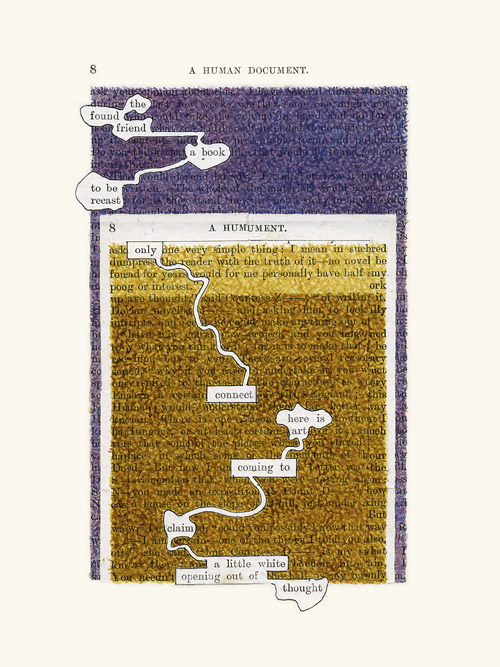
Tom Phillips (PM2); see also Tom Phillips, Humument
home page:
Browse; pick and comment on your favorites

Emil Bønnelycke (Danish, 1893 -1953)
Digital
Cayley and Rosenberg in PM2
Rosenberg in Poetry after 1975 / boundary 2
Digital library: Browse
through the list, but start with
Andrews's "On Lionel Kearns" (try dfiferent browser if this does not run).
Stefans's "Dreamlife," and "I Know Man"
Chang's "Dakota"
bp Nichols' early computer poems
and then Glazier's "Territorio
Libre"
See also: Christian Bok, Xenotext
• What are the distinctive features of this work
• Compose one question for the seminar, based on the reading.
Wreading: Make your own digital poems or create a blueprint/plan for a
digital poem you would like to make
As a final optional submission, please give your response to the course, which exercises and questions you found most helpful, what was your reaction to posting all your work to the list? What about the amount of reading required for each class? Enough? Too Much? What did you like least about the course, what most (what would you like more of, or less of)? Thinking back on all the poets, list your overall favorites and state your reason for your preference.
please try to have all work completed by the last class or email me for extension.
Bonus Track One:
Fernando Pessoa: "Autopsicografia"
Bonus Track Two: Italian poetry modern and contemporary
Eugenio Montale, Guiseppe Ungaretti in PM1
Amelia Roselli in PM2
Elio Pagliarani at PennSound
Il Novissimi, Cesare Pavasse, Eduardo Sanguineti, Antonio
Porta, Adriano Spatola, Luigi Ballerini, Andrea Zonzotto, Milli
Graffi, Emilio Villa, Pier Paolo Pasolini, Milo de Angelis,
Gabriele D'Annunzio, Giulia Niccolai, Antonia Pozzi, Nanni Cagnone
Bibliography
Four: Vienna Group
PM2. pp/ 115-126
Jandl, "Scenes
from Real Life"
Jandl at Ubu
Jandl's "schtzngrmm" (sound poem)
poems/audio at lyrikline
Bonus Track Five: Caribbean Poetry
Kamau Brathwaite
Derek Walcott
Louise Bennett
Claude McKay
Michael Smith
Eduardo Glissant
Malcolm de Chazal
Linton Kwezi Johnson
Bonus Track Six: Brecht & Weil
BONUS TRACK 8
New Zealand/Australia
Alan Curnow
Wystan Curnow
Michelle Leggott
Ern Malley and Angry Penguins (& wiki): the complete poems
John Tranter
John Kinsella
Alan Loney
Javant Biarujia: Tenaraic; interview
Lehto visit (Finland)
many of these links are now broken; a searc should work
Lehto's talk, anthology, and photos of Penn visit
Lehto's short anthology of Finnish poetry..
Introduction to Lehto's work
Lehto's reading at KWH on 2/23/05
Paavo Haavikko in PM2
Background reading (optional):
Leevi Lehto author page
Kalevala (first written version of national "oral"/"folk" epic, 1835) Kalevala in English
Further reading (optional): Scandanavian Poets
Edith Södergran in PM1
Inger Christensen, Gunnar Ekelöff in PM2
Gunnar Björling, tr, Fredrik Herzberg (from boundary 2)
boundary 2 special Swedish supplement: Volume 29, Number 1, Spring 2002 (via Project Muse), includes Jesper Svenbro, Stig Larsson, Ann Jäderlund, Jörgen Gassilewski, Helena Eriksson, Lars Mikae Raattamaa
Eiríkur Örn Norðdahl, "The importance of destroying a language (of one’s own)"
Lehto, "Plurifying the Language of the Trite"
SEE OCT. Update in English 262 for Hallberg/Gasselewski visit.
Wreading:
Try a variant of these three translation exercises using the "Lost in Translation" "Babel" engine, or other web-based translations engines, such as Babelfish and Free Translation.com.
Google Poem: construct a poem using Leevi Lehto's engine (use the patterns feature)._______________________________________
Contemporary French Poety
Claude Royet Journod
Key E-Resouces:
Gale Literature Resource Center
LION
Literary Encyclopedia
Princeton Encyclopedia of Poetry and Poetics
Twentieth-Century American Poetry
"Further Reading" on poetics for "The Practice of Poetics"